
Collagen can be analyzed using several methods. By combining these methods, researchers can distinguish between native and denatured collagen, and the types of collagens, ensuring the efficacy of biological samples and health supplements.
1. Collagen (1)
Collagen is an abundant structural protein in all animals. In humans, collagen comprises one-third of total proteins, accounts for three-quarters of the dry weight of skin, and is the most prevalent component in the extracellular matrix (ECM). Twenty-eight different types of collagens composed of at least 46 distinct polypeptide chains have been identified in vertebrates, and many other proteins contain collagenous domains. Type I collagen exists in skin and tendon, and type II collagen exists in cartilage. Chondrex, Inc. provides ELISA grade collagen as standards for ELISA, WB, general analysis, and validation purposes.
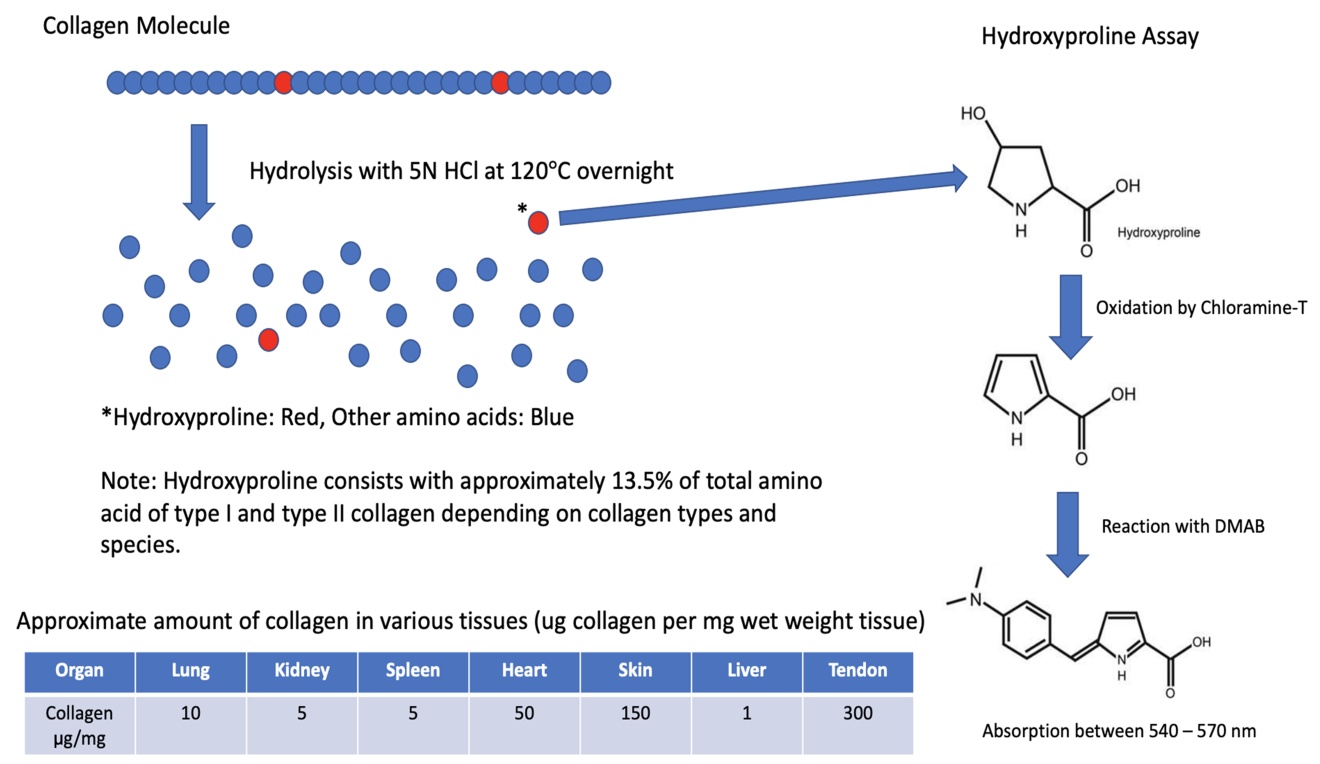
Hydroxyproline exists in specific protein molecules such as collagen and elastin. The uniquely high hydroxyproline content in collagen makes determining accurate levels of this amino acid key for estimating collagen amounts in biological specimens and protein mixtures. Therefore, hydroxyproline analysis is considered the ‘gold-standard’ collagen quantification assay. Because the average amount of hydroxyproline in the total amino acid content of collagen is approximately 13.5%, the collagen concentration in samples can be estimated by 100/13.5 x hydroxyproline concentration (μg/ml). However, the assay does not discriminate between collagen types and species. Moreover, the hydroxyproline content varies among different collagen subtypes; for example, collagen type VI contains less hydroxyproline per chain than fibrillar types.
3. Collagen Assays
3-1. Total collagen analysis using the hydroxyproline assay (4)
The Ehrlich reaction is a useful assay method. Hydroxyproline is oxidized by Chloramine-T to a pyrrole derivative, which reacts with p-dimethylaminobenzaldehyde (DMAB) in an acid medium, resulting in a colored product. Before starting the assay, samples must be hydrolyzed in 5N HCl at 120 degrees C overnight to reduce any collagen present into single amino acids . Please refer to our hydroxyproline assay kit for more information.
3-2. Total collagen analysis using Sirius-red assay
Sirius red is a unique dye which specifically binds to the [Gly-X-Y]n helical structure on fibrillar collagen (type I to V) and does not discriminate between collagen species and types. With this, Sirius Red works for detecting the total native collagen content in various collagen-containing samples such as tissue specimens, cell culture media, and cultured cells. This assay requires collagen solubilization from samples. Please refer to our Sirius-red collagen assay kits in both tube format and 96-well plate format for more information.
3-3. Individual types of native collagen analysis using ELISA
Generally, monoclonal antibodies (mAbs) developed by native collagen immunization are highly specific to native collagen due to the completely different structure between native and denatured collagen. Therefore, ELISA utilizing monoclonal antibodies can be used for detecting solubilized native collagen in samples. Please see our variety of multi-species ELISA kits for type I and type II collagen for more information.
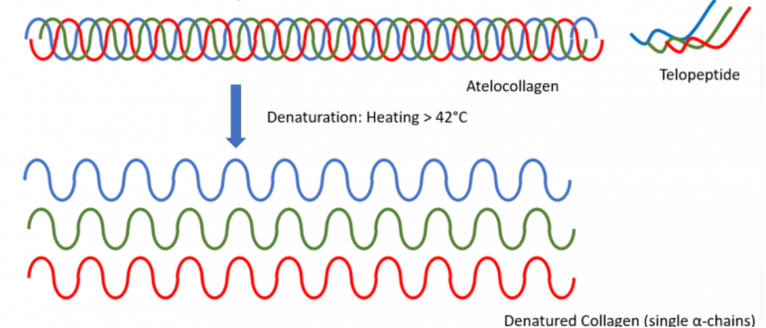
Recently, native type II collagen has been used as a supplement for joint health in humans (5), dogs (6, 7), and horses (8). To analyze the native type II collagen content in supplements, a sandwich ELISA which employs native type II collagen specific antibodies is available. In addition, comparing the results from the native type II collagen detection assay and the total collagen content as assayed by the hydroxyproline assay is important in quality control assays (9) because native collagen content should correlate with the biological efficacy of the supplements. Total collagen amounts also reveal co-existing denatured type II collagen and other types of collagen such as type I collage during the sample preparation process and manufacturing process.
4. Determining Denatured Collagen in Samples
Denatured collagen levels in samples can be obtained by subtracting native collagen amounts as determined by ELISA from total collagen amounts as determined by the hydroxyproline assay.
References
2. R. E. Neuman, M. A. Logan, The determination of hydroxyproline. J. Biol. Chem. 184, 299–306 (1950).